

Can You Keep Ice From Melting?

During this investigation, you are going to explore how ice melts. You will be exploring the testable question, “Can I affect the rate at which ice melts?” To do this, you will make some predictions about what makes a good insulator or what would slow the rate of ice melt. Using a control, you will record the rate at which your ice cube melts. You will be comparing your findings with the findings of others in the class. Following the inquiry, you will draw conclusions about insulators and give an explanation for why the control was important for this experiment.
Allow a planning session that will take 15-30 minutes. (I gave a prompt as a homework assignment the night before.) Prepare containers (5-10 minutes); wait for ice to melt (1/2 day or more); write-up (15-30 minutes).
Instructional Support Downloads
Task Write Up
- Cause and effect
- Change, constancy and measurement
- Evidence, models and explanation
- Properties and changes of properties in matter
- Ask a question about objects, organisms, and events
- Communicate investigations and explanations
- Employ simple equipment and tools to gather data
- Make observations
- Plan and conduct a simple investigation
- Use data to construct a reasonable explanation
- Data collection, organization, analysis
- Graphs, tables, representations
- Measurement
- Ratios/proportions
Suggested materials
This activity requires little advanced preparation and minimal materials. A yogurt cup for each student and one for the control, ruler, ice cubes, (approximately the same size), and the materials the student chooses to use as insulation, brought from home. For students who do not bring in materials, you might have various types of cloths, paper, plastic, Styrofoam packing peanuts, etc., on hand.

Exemplars Rubrics
Students should be able to determine what materials made better insulation by comparing melt times (some of the classroom’s best included snow and newspaper). Students show their understanding of the term control throughout the experiment by explaining its importance in relationship to this inquiry. The student should be able to explain that it is necessary to compare the melt time of an ice cube in an insulated cup with the melt time of a cube in a cup without insulation to determine if the insulation is effective. The student should also be able to determine what s/he might do differently next time. Some students may think of something new they would like to test that wasn’t tried during the inquiry.
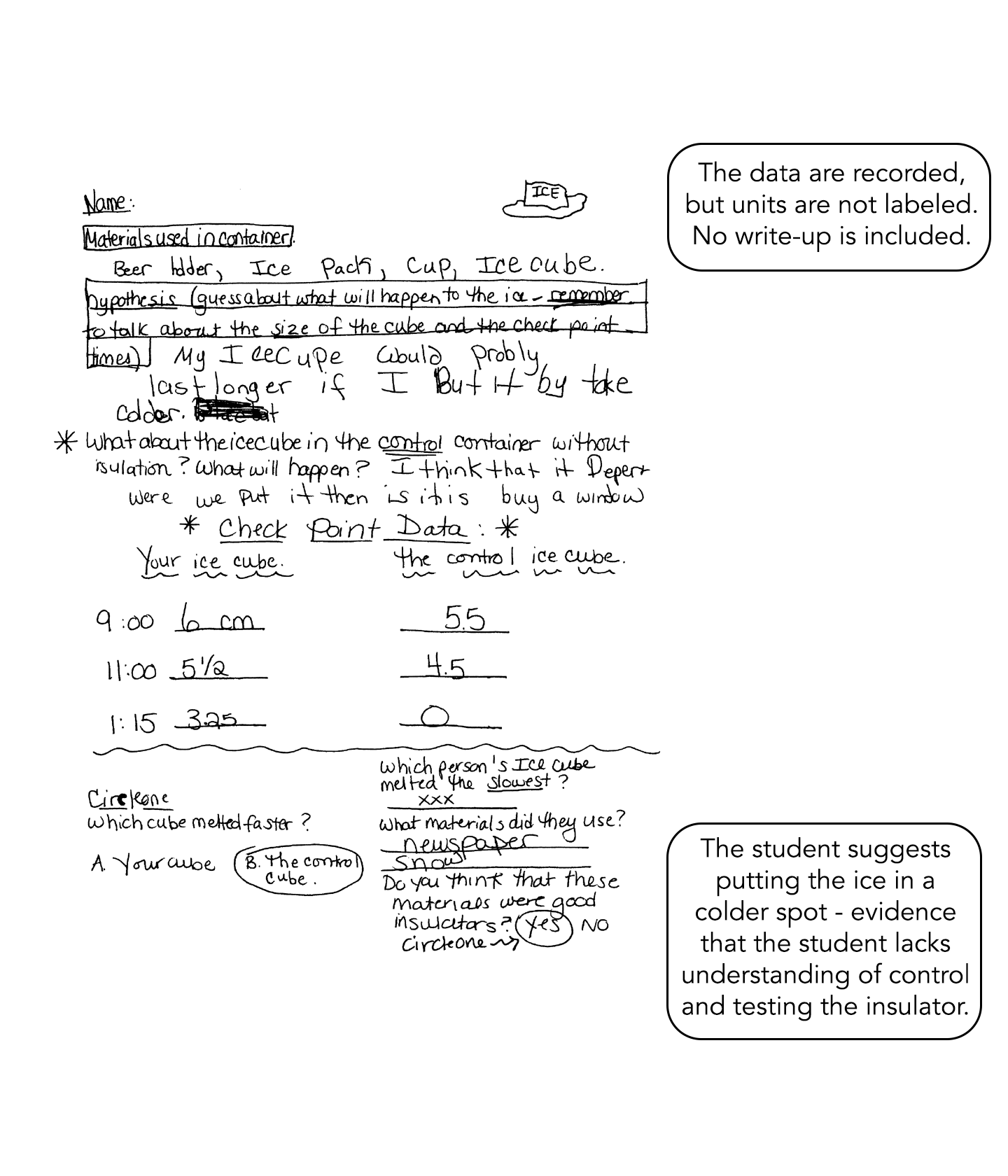
This student’s solution is lacking in detail and shows little understanding of what would make a good insulator. S/he also states that the cube will last longer in a colder spot, despite being told that all the cups would need to remain in the same spot. The student’s data are recorded, but units are not labeled. There are no conclusions drawn from the data. The task is incomplete.
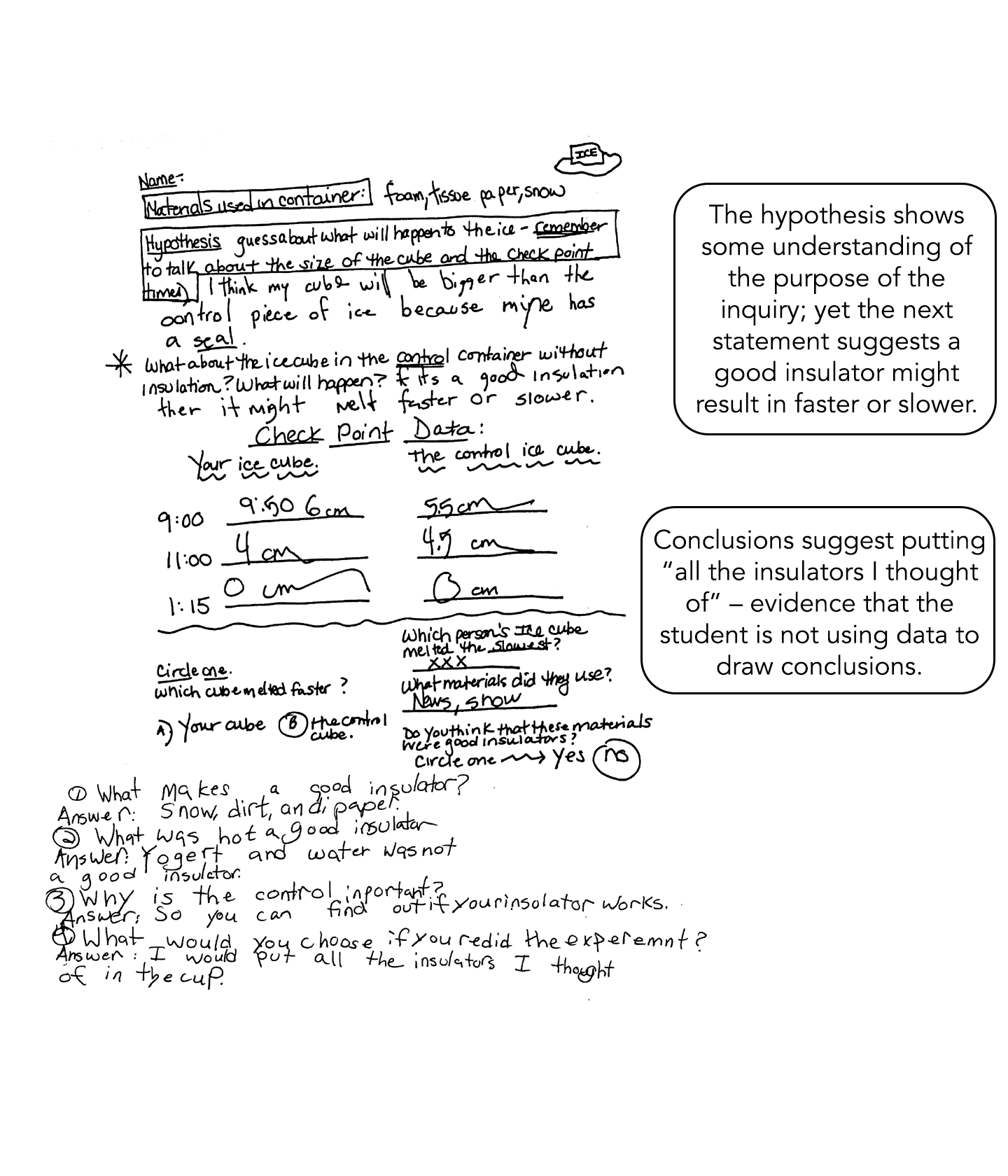
This student’s work shows that s/he was able to understand the purpose of the inquiry and the use of control. The hypothesis, “I think mine will be bigger than the control piece of ice because mine has a good seal,” demonstrates some understanding; however, the student then states, “If it’s a good insulator then it might melt faster or slower,” which is confusing at best. The statement, “Control is so you can find out if your insulator works,” is a brief response showing some understanding. When the student comments on what s/he would do differently, it is not clear what materials the student is referring to (“all the insulators I thought of”) – evidence that the student is not using data to draw conclusions.
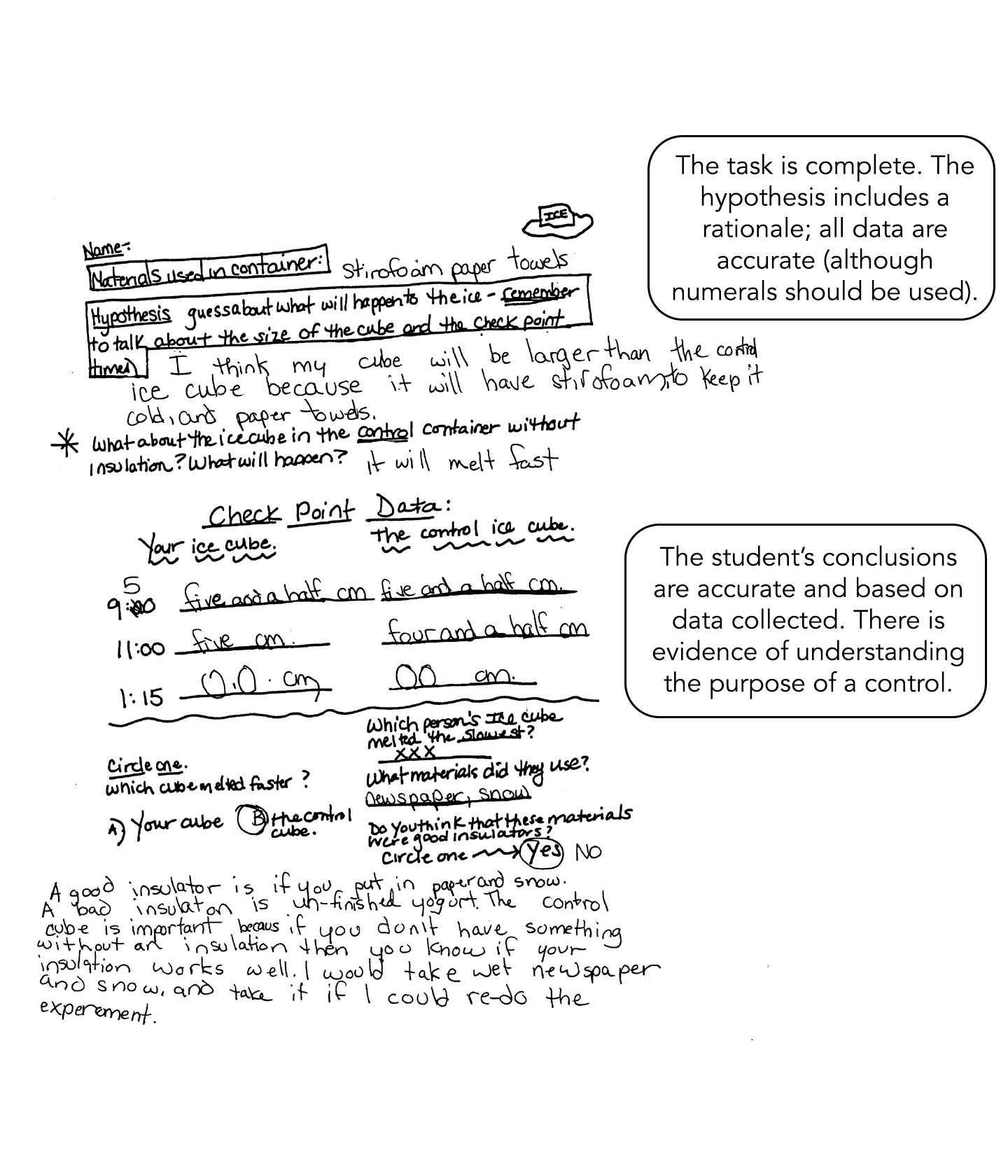
This student’s solution is complete. In the hypothesis, the student gives a reasonable explanation of which cube will last longer and why s/he believes it will be larger. Measurements are precise (although numerals should be used), units are labeled, and all data are recorded correctly. Conclusions are based on data collected and show evidence that the student understands the purpose of using a control.
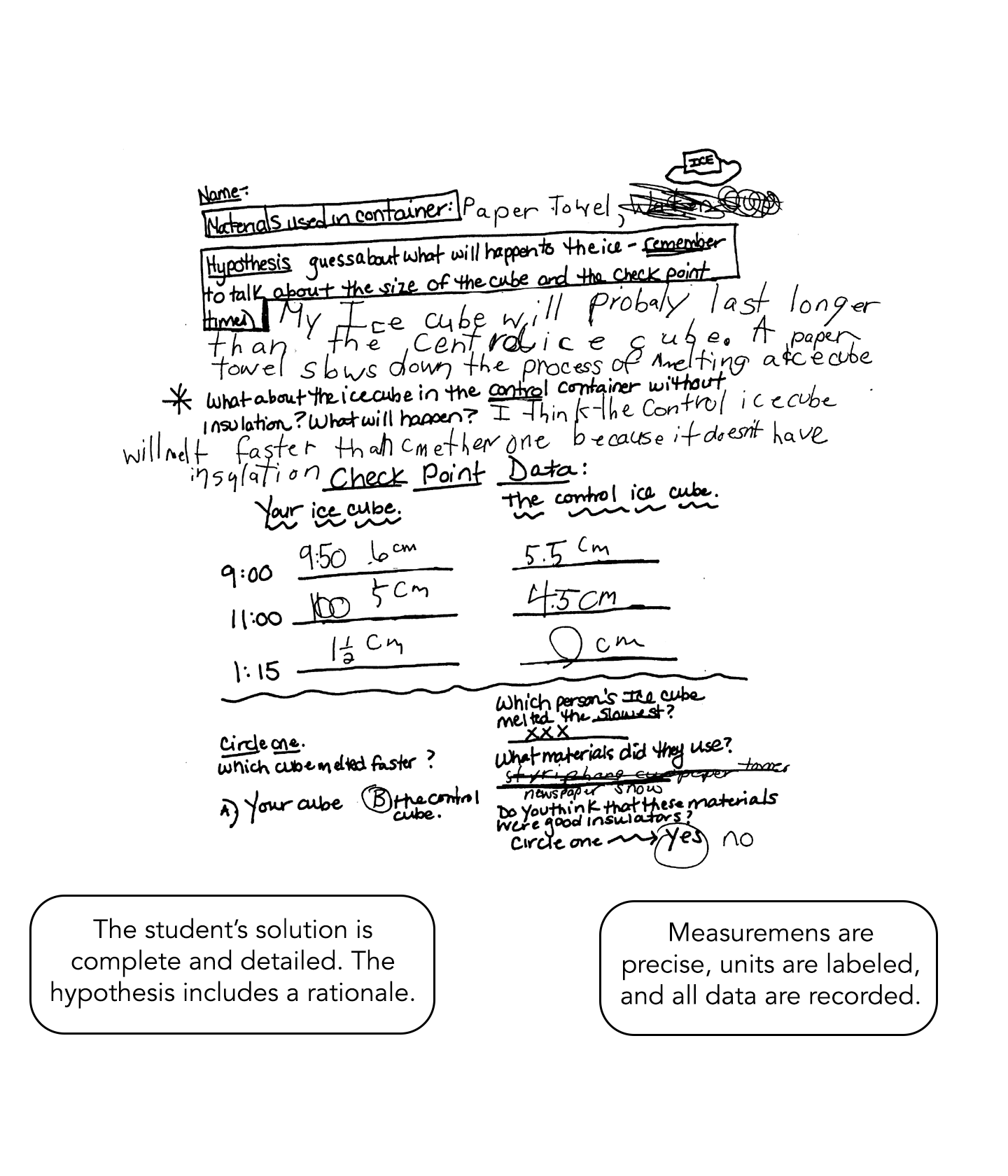
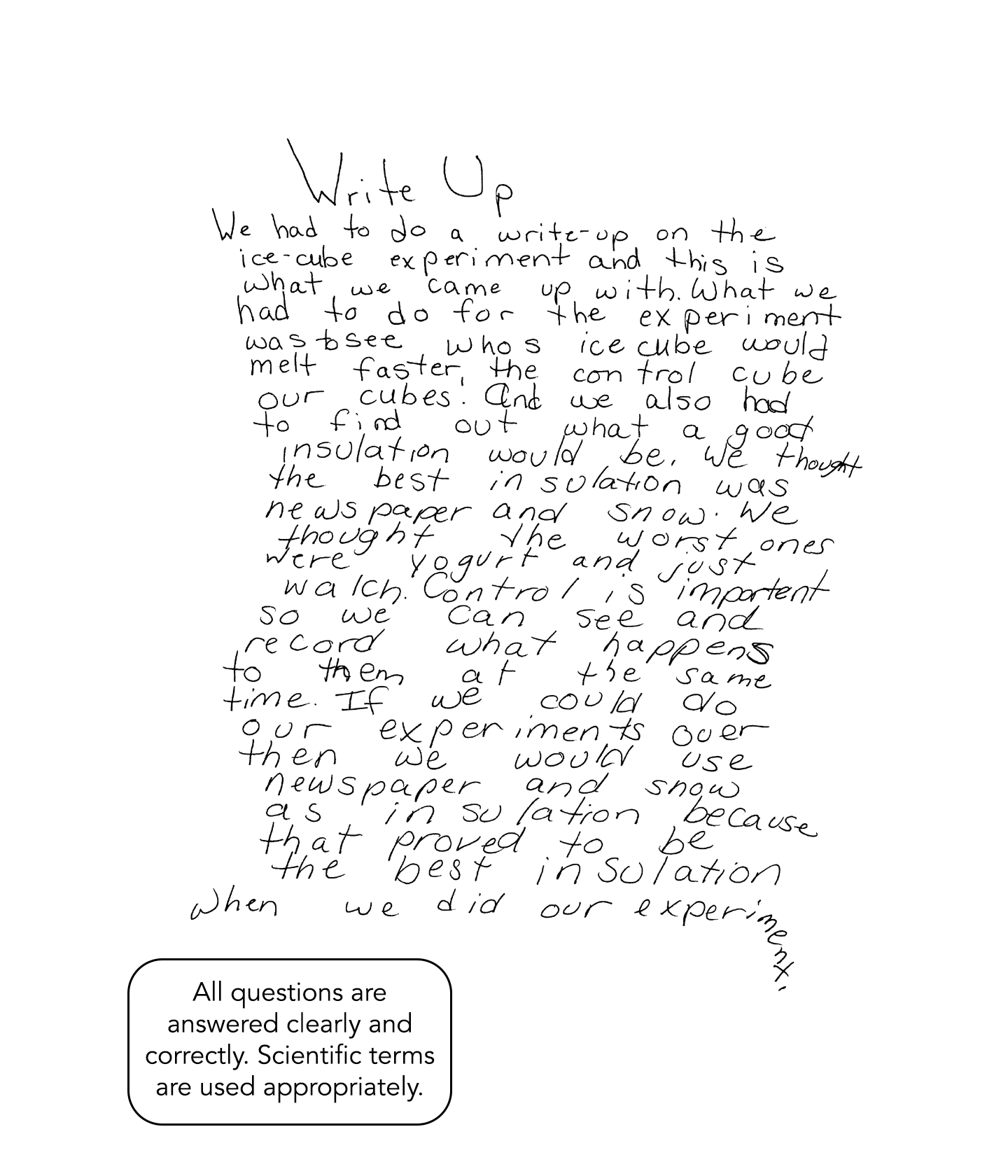
This student’s solution is complete, accurate and detailed. In the hypothesis, the student gives a reasonable explanation of which cube will last longer and why s/he believes it will last longer (“paper towels will slow the process of melting an ice cube”). Measurements are precise, units are labeled, and all data are recorded correctly. Scientific terms are used appropriately.